
6. Blockchain Utility Suite
Blockchain Explorers
Blockchain explorers are applications that let users view all the transactions that occur on a blockchain in real time. Instead of having to use a terminal or command prompt system to look through the blockchain database, explorers give users a proper user interface to view this data. While each chain generally has its own explorer, they are all modeled in a very similar and easy-to-use interface.
A blockchain explore lets users view the entirety of the activity on chain. It provides real time data of all transactions occurring on the chain, where a user can literally click on a new block and see the full list of transactions that appear on it. Explorers have a search tool on them as well where a user can type in a transaction, block, or wallet hash, as well as project and domain names directly, to immediately find that item on-chain.
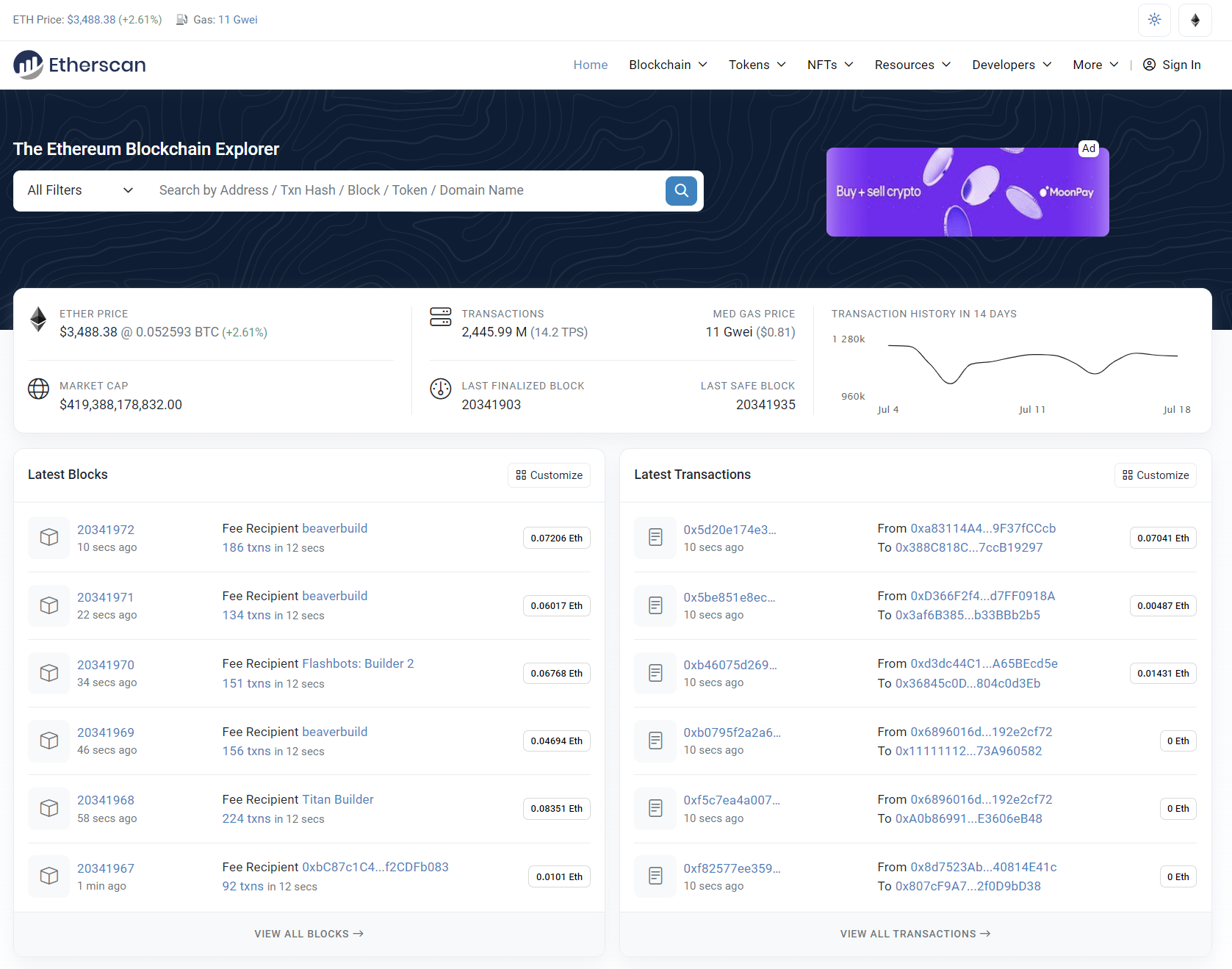
Source: Etherscan
Smart contracts stored on-chain can directly be viewed in an explorer, where a user can view the smart contract code itself as well as all the transactions that have interacted with it. Being able to directly view smart contract code means that anyone can audit published contracts in order to determine their security and trustworthiness. Most explorers make developers verify their smart contract code once it’s deployed to ensure that the code they provided is the exact match of the deployed on-chain bytecode, or the actual contract users will interact with.
Etherscan is Ethereum’s blockchain explorer and gives users real time information on the state of the network. Users are able to view blocks and their transactions, public addresses, smart contracts, current gas metrics, and all the other data taken directly from the network.
Blockchain explorers are a powerful tool because they let a user see directly into a blockchain’s database and use all of that data to their advantage. Anyone can scroll through the list of incoming transactions to see:
- The movement of money across the chain
- Token addresses and who is holding those tokens
- Deployed smart contracts, their code, and what assets they hold
- Public wallet addresses and their holdings
- The inner workings of the EVM
… and so much more. Blockchain explorers offer a completely public and open source view into the world’s largest decentralized databases.
Other chains have similar layouts to Etherscan for their explorers but are slightly modified to fit the criteria required for that chain. Here are a few of the popular explorers:
- Blockchain.com - Bitcoin explorer
- Polygonscan - Polygon explorer
- Snowtrace - Avalanche explorer
- Solscan - Solana explorer
- Era - ZKsync explorer
To learn more about the full possibilities that blockchain explorers offer, check out the Etherscan Information Center that contains useful how-to guides and a full list of the data the explorer offers, as well as this guide by Koinly on how to effectively utilize explorers.
📋 Practice Question